
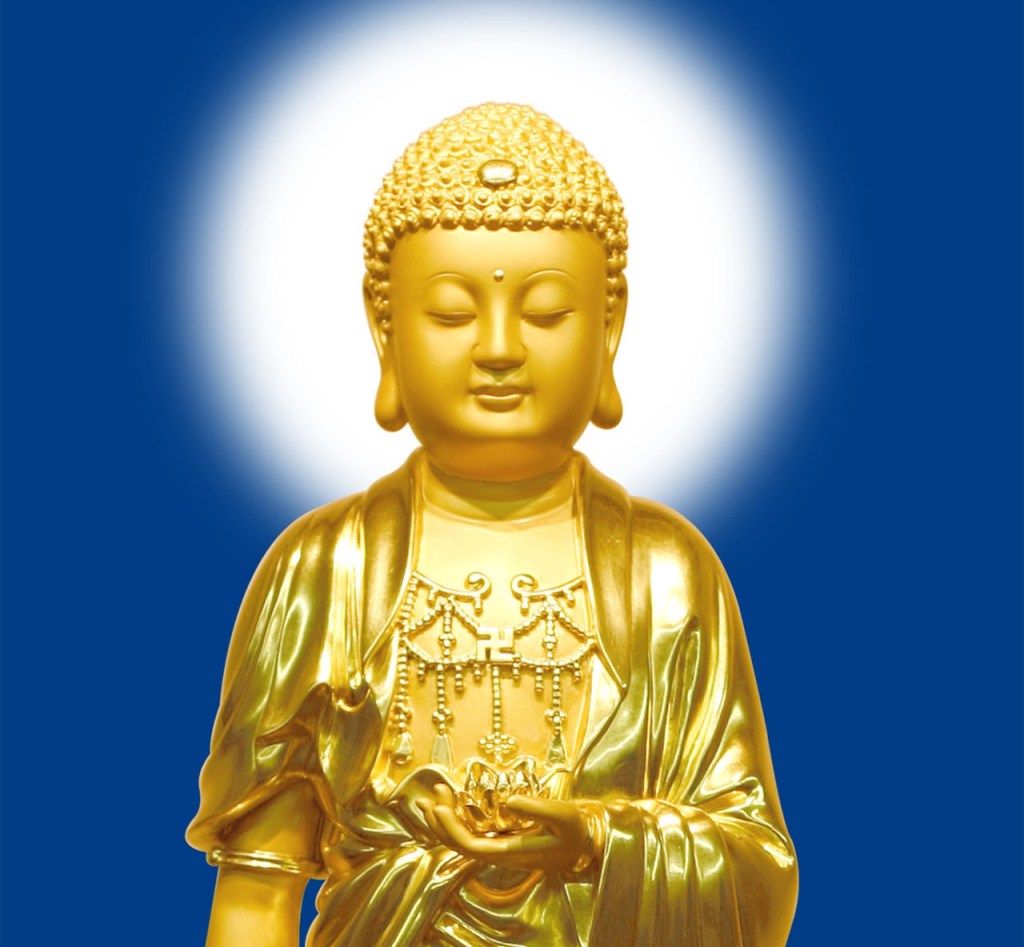
The lesson today is the first one. Religious organisations entering UNESCO is a good deed. UNESCO affirms that religions around the world are education but not superstition. Many friends asked me, ‘Is religion education?’ They find the concept strange. I replied to them, ‘You see, the founder of every religion in the world, similar to Sakyamuni Buddha, devoted themselves in teaching.’ Sakyamuni Buddha, at the age of 30, showed us an example and attained full awakening. After attaining full awakening, he thoroughly understood everything about the universe and life. Then, he went to the Deer Park in the north of ancient India, found his five colleagues and delivered to them his first report.
Listen to my teacher’s original lecture: God Loves All Beings
Listen to the podcast in English: What is religious education? All religions are one big family..
Listen to Amituofo Chanting.
Sakyamuni Buddha started his teaching career from there. Up until this year, the Buddha’s teachings have been passed on for 3,000 years. Let’s take a close look at other religions that emerged later than Buddhism. Many of them, in the past 1,000 years, were also spread one after another across the world. Up until now, over ten religions that we are familiar with have successfully taught generations of humankind. However, we must have a correct understanding of what the Chinese phrase宗教 (zongjiao, religion) means.
Sinographs (or Chinese words) are unique in the world and they are also an excellent traditional culture. They are not alphabetic. Each sinograph is embedded with profound meanings. Let’s look at the two sinographs宗 and教, one by one. The sinograph ‘宗’ (zong) has three meanings. 1) principal, 2) important, and 3) revered. The sinograph ‘教’ (jiao) also has three meanings. 1) education, 2) teaching and 3) transformation. Religion completely encompasses all of these meanings. When combined, the phrase宗教zongjiao (or religion) means principal education for humankind, important teaching for humankind and revered transformation for humankind. You might ask, ‘Really?’ Well, if you don’t believe it, you’re welcome to take a close look for yourself.
Buddhism has been taught and practised in China for 2,500 years. Indeed, it has a place in traditional Chinese culture. The Chinese have preserved the richest collection of Buddhist literature, and it is called ‘The Tripitaka大藏經’. It has a significant place in traditional Chinese culture.
Throughout Chinese history, Buddhist patriarchs and other awakened practitioners were similar to what Sakyamuni Buddha did. They had all engaged in Buddhist education throughout their lives. In every dynasty or every century in Chinese history, there were outstanding Buddhist masters, be they ordained monks, nuns or lay Buddhist practitioners. Those who practise in a household are householder-practitioners or laities. All of these Buddhist practitioners of master-level are evidence [of religion being education].
Now, you might ask, ‘Since religion is education, what does it teach? What does its curriculum include?’ In all sacred religious texts, as all of you can see, there is education in moral principles of handling human relationships, there is moral education, there is education in the law of cause and effect, there is education in wisdom. [When a person is] awakened, fully awakened, it is the perfect wisdom of their original nature taking effect. Their innate perfect wisdom arises. In Buddhism it is called attaining the fruit of full awakening.
Over 2,000 years ago, Buddhism was introduced to China in the Eastern Han dynasty, about 500 years after Confucius’ time, or a few years before Jerusalem was destroyed by the Romans in the West. That’s why Buddhism also became an indispensable part of traditional Chinese culture. Speaking of traditional Chinese culture, Confucius’ teachings, the Buddha’s teachings and Daoist teachings are the representatives. All of these three teachings include moral principles of handling human relationships, morality, the law of cause and effect, and the teachings of sages. The sages of these three teachings, after having attained full awakening, also devoted themselves in teaching and left behind many resources.
At the beginning of the Tang dynasty, Emperor Taizong (599 CE), Li Shimin, commissioned five most virtuous and knowledgeable officials to compile a book entitled ‘The Governing Principles of Ancient China’. So, what’s the book about? It is a collection of the essence of traditional Chinese culture. Emperor Taizong used this book to cultivate himself, bring good order to his family, bring stability and prosperity to his country and bring peace to the world.
The 300-year history of the Tang dynasty was like an experiment in traditional Chinese culture. It was really effective. It was effective back then. It is still effective today. Using the wisdom conveyed in ‘The Governing Principles’ to govern a country, I believe, a person will obtain excellent results in governance. They will become a great role model for other political leaders.
The Buddha’s teachings are deeply rooted in China. Chinese emperors of almost every dynasty respectfully followed the Buddha’s teachings. It was observed throughout history. Up until today, ancient Buddhist monasteries still exist. They can be the witnesses of that part of history. So, what did the Buddha teach? As mentioned before, he taught moral principles of handling human relationships, morality, the law of cause and effect, and the wisdom that practitioners in ancient times had obtained by cultivating themselves. These were not only useful for their contemporaries, but also useful for generations to come.
This book has been translated into more than ten languages. I believe that, if every national leader reads this book, they will not only strengthen their country but also use true wisdom and lessons learned in history to transform disasters caused by numerous antagonism and wars in the world.
All of us hope that this planet can head towards stability, harmony, mutual prosperity and coexistence. World peace is what we all pursue. This book can help bring stability and prosperity to a country and bring peace to the world. It has its real merit. Religious education and what is taught in this book complement one another.
First of all, we should have a healthy mind and body. It has been nearly two months that I haven’t given lessons on the Buddha’s teachings. I feel that I should apologise to fellow practitioners. What did I do in the past two months? I recuperated for a while. It had some effect. The ancient Chinese said, ‘Time spares no man.’ And it is very true. I am 92 now. Aging is taking its course. My vision is not as good as before. In the past I didn’t need glasses when reading. But now I can’t read without them.
I also need to wear a hearing aid. As for writing, I can now truly experience what the ancient Chinese said ‘forgetting words when one is about to write’. It is not just me. I have two old fellow students, Professor Xu Xingmin and Professor Jiang Yizi. When we met up last time, all of us deeply felt, ‘We are old!’ Our energy and physical strength are far worse than a couple of years ago. There is a big difference between now and then. So, I stopped Dharma lessons for a while and recuperated. Not bad, it had some effect.
Well beyond my expectation, UNESCO assigned us a task, that is, helping the world transform conflicts and antagonism, hoping to bring religions and ethnical groups together. To achieve that, all of us need to broaden our minds, accommodate other people, accommodate different religions and different ethnical groups. Because we are a big family. So, in the past two months I revisited the sacred texts of different religions.
The book ‘Scriptures 360’ collects the most essential teachings found in the sacred texts of different religions. The core religious thought is the focus of our learning. So, what is the core teaching? It is one word, ‘love’. In the sacred texts of all religions, there is mentioning of universal love, love of benevolence and love of humility. Therefore, one sentence encompasses all of them, ‘God loves all beings’. This is the core idea of religious education.
We should retrieve our love. Our love is exactly the same as the love of God. There is no slightest difference between them. We retrieve it and keep it in our hearts. Discard our deluded minds and all sorts of thoughts. Keep our true mind (awakened mind) and love. On behalf of God, on behalf of Buddhas and bodhisattvas, on behalf of Allah, we love everyone in the world. This is religious education.
Its curriculum covers four subjects. Education in moral principles of handling human relationships, moral education, education in the law of cause and effect, education in sages’ wisdom. We must learn them properly. Moral principles of handling human relationships have been abandoned. We must find them and bring them back. If we want social stability and world peace, we must bring it back.
Ancient Chinese sages and the virtuous greatly emphasised education. What they taught was also these four subjects. Therefore, when the Buddha’s teachings were introduced to China, the Chinese could immediately accept them. Why is it? Because what the Buddha taught is very close to what ancient Chinese sages and the virtuous taught. There is no difference. In this day and age, science and technology are highly developed, but the four subjects of education are all missing.
In science, there is something close to wisdom, but the law of cause and effect, morality and moral principles of handling human relationships are all missing. That is why, today, the rich are not happy and those of high social status are not respected. So what has become most important in the world? Money. Under this circumstance, how could society possibly stay away from chaos?
Therefore, we do not want to disappoint UNESCO’ affection and friendship for us and for religions in the world. We are most grateful that UNESCO offered us an office. We must bring back sacred religious education, and learn and practise it properly.
We learn and practise our own religions first, and then learn from other religions, seeking common grounds and putting aside differences. Our ultimate goal is that there will be no more conflicts, no more antagonism and no more misunderstanding. We hope that, on this planet, true love of benevolence and peace will be realised.
That is why, in this first lesson, I talked to you about understanding the true meaning of religion. This is it for today. Thank you.
學習《神愛世人》 (Lesson One)15.06.2018 檔名:21-786-0001
DEDICATION
The effort and gains of explaining, transmitting and listening to Buddhas’ teachings are dedicated to:
the entire Universe and all beings of all dimensions and all existences. May they all listen to Buddhas’ teachings, awaken to the truth of the Universe, be mindful of the name ‘Amituofo’ (Amitabha Buddha),
aspire to go to the Pure Land, and become Buddhas. (Read the above three times)
I pray to Buddhas and bodhisattvas for unconditionally solving all man-made and natural disasters around the globe.
For all of those who died in man-made wars and natural disasters across the world,
and for all of those who are related to me in all kinds of ways in this life and previous lives, may they listen to Buddhas’ teachings. May they awaken to the truth of the Universe, aspire to unearth their innate and most sincere, pure, equal and awakened mind, be single-mindedly mindful of Amituofo, aspire to go to the Pure Land so as to see Amituofo and listen to his teachings, removing all their delusions and unveiling their innate wisdom, gaining the real peace and happiness, instantly escaping from the cycle of birth and death, speedily becoming Buddhas, and helping all beings (in the entire Universe) like all other Buddhas.
The effort and gains are dedicated to the leaders of all countries on the Earth. May all countries be prosperous. May all disasters be solved. May the world enjoy eternal peace. I use the effort and gains to return the help from the enlightenment of Buddhas, by the correctness of Buddhas’ teachings, from the purity of sangha, from all beings, from my parents (in this life and previous lives), and from my country(ies). I also use the effort and gains to help alleviate the suffering of those who are already in and will be reborn into the animal realm, the ghost realm and hells as the result of their bad thoughts, speech and deeds. For anyone who sees and hears me chanting or being mindful of Amituofo and doing other good deeds, may they aspire to unearth their most sincere, pure, equal and awakened mind so as to go to the Pure Land of Ultimate Bliss, together with me, at the end of our present lives.
 Learning and Practising Buddhism
Leave a comment